Employees are widely assumed to be the primary beneficiaries and cost drivers in group health insurance plans. The data tells a different story. According to Pazcare's Employee Health Matters Handbook 2026, parents drive 66% to 68% of all eye disorder claims and 89.6% of ranked cancer claims under group insurance for employees. Across all categories, a parent cardiac claim costs 50% more than an equivalent employee claim.
The highest-value claims in group health insurance are not random. They are predictable, age-linked, and concentrated in five treatment categories: cardiac surgery, cancer treatment, renal care, orthopedic procedures, and cataract and eye surgery. HR teams that understand this pattern can plan for it structurally rather than being surprised at every renewal.
Managing parental claims does not require reducing employee benefits. It requires smarter group health insurance plan design: separate sum insured for parents, co-payment structures, preventive care integration, and broker support that uses claims data rather than guesswork. This blog gives HR teams the framework to do exactly that.
Employees are widely assumed to be the primary beneficiaries and cost drivers in group health insurance plans. The data tells a different story. According to Pazcare's Employee Health Matters Handbook 2026, parents drive 66% to 68% of all eye disorder claims and 89.6% of ranked cancer claims under group insurance for employees. Across all categories, a parent cardiac claim costs 50% more than an equivalent employee claim.
The highest-value claims in group health insurance are not random. They are predictable, age-linked, and concentrated in five treatment categories: cardiac surgery, cancer treatment, renal care, orthopedic procedures, and cataract and eye surgery. HR teams that understand this pattern can plan for it structurally rather than being surprised at every renewal.
Managing parental claims does not require reducing employee benefits. It requires smarter group health insurance plan design: separate sum insured for parents, co-payment structures, preventive care integration, and broker support that uses claims data rather than guesswork. This blog gives HR teams the framework to do exactly that.
Introduction: The real cost driver in group health insurance
Most employers design their group health insurance plan with employees in mind. The sum insured, the room rent cap, the network hospitals, the claim process, all of it is calibrated around a working-age adult with moderate and infrequent health needs. Parents are included as a dependent category, often without much structural thought beyond whether to add them and at what premium. That asymmetry is the origin of most group health insurance renewal shocks in India.
As Pazcare's Employee Health Matters Handbook 2026 documents, drawing on 77,000 insurance claims across 400,000 covered lives over five years: the highest-cost claims in group insurance for employees do not come from the employees themselves. They come from dependents, and specifically from parents, who require cardiac surgery, cancer treatment, renal care, orthopedic procedures, and cataract surgery at rates that are structurally predictable and financially significant.
This is one of the most consistently misunderstood aspects of corporate health planning. Employees are seen as the primary beneficiaries. In reality, the highest-cost claims come from dependents, especially parents, who require cardiac surgery, cancer treatment, renal treatment, chronic disease management, and cataract procedures, all of which are medically necessary, often unavoidable, and predictably expensive.
Understanding which treatments are driving those claims is not an academic exercise. It is the foundation of a group health insurance policy that is financially sustainable, employee-friendly, and renewal-predictable.
Why parents drive higher claims in group insurance for employees
The reason parents generate larger and more frequent high-value claims than employees is structural, not circumstantial. It comes down to three converging factors.
Age-related disease burden. India's aging population is carrying an enormous non-communicable disease load. The ICMR-INDIAB study found that the prevalence of hypertension in India stands at 35.5%, with an estimated 315 million people having hypertension. The high prevalence of generalized obesity at 28.6% and abdominal obesity at 39.5% suggests the likelihood of further increases in diabetes rates, and the high prevalence of hypercholesterolaemia points to significant cardiovascular disease risk. These conditions predominantly manifest and escalate in the 55-plus age group, which is precisely the cohort that most group insurance for employees covers as parents.
Delayed diagnosis and compressed treatment timelines. Parents in India frequently present to hospitals at advanced stages of conditions that had been progressing undetected for years. A parent who is diagnosed with a cardiac blockage at age 64 did not develop that condition overnight. The absence of regular preventive screening across most of their life means that by the time the claim hits the group health insurance policy, the intervention required is maximum-cost: bypass surgery rather than medication management, dialysis rather than early-stage kidney disease treatment, chemotherapy for advanced cancer rather than an early surgical removal.
Higher hospitalization frequency and longer stays. Older patients take longer to recover from surgery, are more likely to develop post-operative complications, and require more intensive post-hospitalization care. A cardiac surgery claim for a 68-year-old parent will typically include a longer ICU stay, more post-operative consultations, and a higher pharmacy bill than the same procedure for a 42-year-old employee.
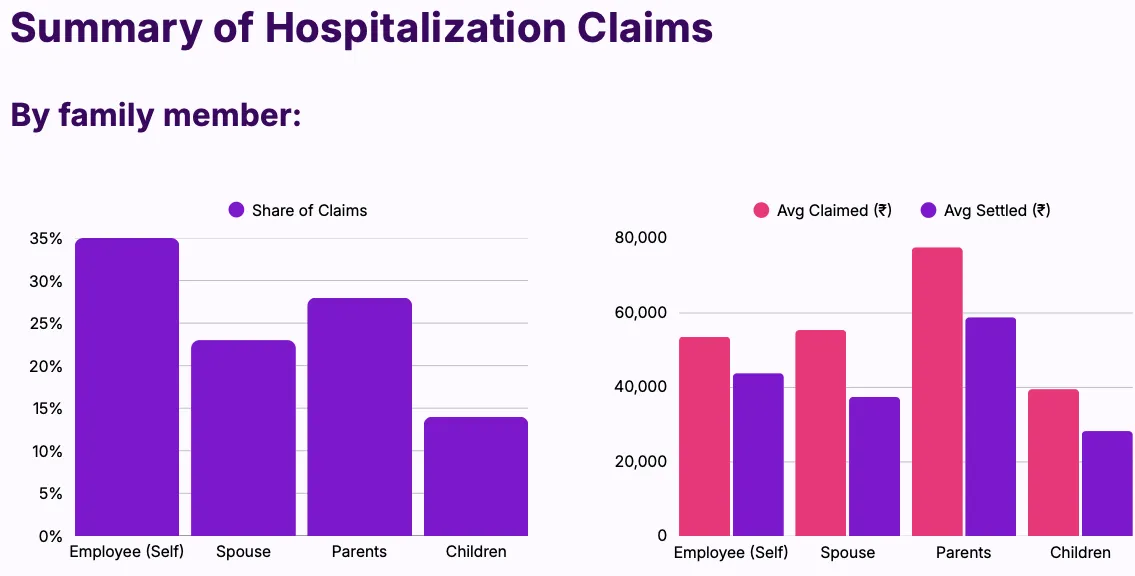
The result, as Pazcare's claims data shows, is a claim severity differential that is significant and consistent. A parent cardiac claim costs 50% more than an equivalent employee claim. Parent cancer claims, driven by advanced-stage diagnoses, generate cumulative costs that frequently exceed the base sum insured of many group health insurance plans.
Where the costs come from: Frequency vs Severity
Understanding the cost structure of parental claims requires separating two distinct metrics that HR teams often conflate: claim frequency and claim severity.
Parents do not necessarily file claims more often than employees. In fact, employees tend to have higher claim frequency overall because they are using the group health insurance plan for a wider range of conditions throughout the year. What parents generate is higher claim severity, meaning that when they do file a claim, the cost per claim is substantially larger.
A single cardiac surgery claim from a parent can equal 10 to 15 times the value of typical outpatient claims filed by employees in the same year. A renal transplant or a cancer chemotherapy cycle is not a one-time claim: it is the first of many, filed repeatedly over months or years, each one adding to the annual claims ratio that determines the group health insurance premium at renewal.
This concentration of high-value, often recurring claims in a small segment of the covered population, the parent dependents, is what makes parental claims disproportionately influential in group insurance policy economics. An HR team with 200 employees and 120 enrolled parents may find that 15 parents are responsible for 60% of the total claims value in a given year.
Top 5 treatments driving parental claims in group health insurance plans
1. Cardiac surgeries
Cardiac procedures are consistently the highest-value claim category in group health insurance plans that include parents. This encompasses bypass surgery (coronary artery bypass grafting or CABG), angioplasty with stenting, valve replacement, and pacemaker implantation.
According to an ICMR-funded review of cardiovascular disease burden in India, CVDs strike Indians a decade earlier than the Western population, with the age-standardized CVD death rate at 272 per 100,000 population, significantly higher than the global average of 235. The burden of hypertension, a primary driver of cardiac events, is estimated to affect over 315 million Indians.In the 60-plus age group, which represents the majority of enrolled parents in corporate group insurance policies, the probability of a cardiac event requiring surgical intervention is materially high and increases with each year of age.
Cardiac procedures, cancer therapies, and organ-related surgeries in India often cost Rs10 lakh to Rs25 lakh. Even non-critical hospitalizations for complications can drain a mid-single-digit lakh cover quickly.
Why it is expensive: Cardiac surgeries require pre-operative diagnostics including angiography and echocardiography, ICU stays of 3 to 7 days post-procedure, surgeon and anesthesiologist fees, expensive consumables including stents and grafts, a hospital stay of 7 to 14 days depending on complications, and extensive post-operative follow-up and medication. A single CABG procedure at a private hospital in a metro city can range from Rs4 lakh to Rs10 lakh or more depending on the hospital tier and the complexity of the procedure.
For HR teams: A private hospital cardiac admission in Telangana costs Rs95,095, 70% above the national average of Rs55,870, as documented in the NSS 80th Round released by the Ministry of Statistics and Programme Implementation in April 2026.Hospital location and tier have a direct impact on cardiac claim costs, which means group health insurance plans with metropolitan parent-heavy enrolled populations carry structurally higher cardiac claim risk.
2. Cancer treatments
Cancer is the most financially devastating claim category in group health insurance because it combines high per-episode cost with long treatment duration. A parent diagnosed with cancer does not generate one claim. They generate a series of claims across months or years: surgical removal, followed by chemotherapy cycles, radiation sessions, targeted therapy, and ongoing follow-up scans.
According to the NSS 80th Round, a private hospital cancer stay in Tamil Nadu costs Rs1,35,368, nearly five times the Rs28,864 paid in Odisha for the same condition. Insurance has not closed the gap: even after reimbursement, out-of-pocket medical expenditure in Tamil Nadu's private hospitals runs to Rs74,168 per hospitalization.
According to Pazcare's Employee Health Matters Handbook 2026, 89.6% of ranked cancer claims under group insurance for employees come from parents. A parent cardiac claim already costs 50% more than an employee equivalent. Cancer claims, which compound over time, are the fastest-growing and least-visible cost exposure for any HR team managing a group health insurance plan with parent coverage.
The impact on group health insurance cover is threefold. First, cumulative treatment costs across a multi-year cancer journey frequently exceed the base sum insured of many SME group policies. Second, each renewal following a cancer diagnosis carries a significantly elevated claims ratio that translates directly into premium loading. Third, if the group health insurance policy has sub-limits on specific cancer treatments, the employee's family faces out-of-pocket exposure precisely at the moment of maximum financial stress.
3. Renal (kidney) treatments
Renal failure and chronic kidney disease present a unique challenge in group health insurance: they are both expensive and recurring. Dialysis is not a one-time claim. It is a biweekly or thrice-weekly intervention that generates multiple claims per month, every month, indefinitely, until the patient either receives a kidney transplant or can no longer continue treatment.
The ICMR-INDIAB study documents that diabetes affects a significant proportion of India's adult population, and hypertension prevalence stands at 35.5%. Both diabetes and hypertension are the primary upstream causes of chronic kidney disease in India, making renal failure a condition that is heavily concentrated in the 60-plus age group that forms the parent cohort in corporate insurance plans.
The cost structure of renal claims: each dialysis session at a private hospital costs Rs2,000 to Rs5,000. Two to three sessions per week, 52 weeks a year, means an annual dialysis cost of Rs2 lakh to Rs7.5 lakh per parent, before adding hospitalization for infections, complications, and medication. A kidney transplant, when it becomes viable, is a one-time cost of Rs5 lakh to Rs15 lakh or more depending on the hospital, but it replaces the ongoing dialysis cost.
The key concern for HR teams managing group health insurance is that dialysis claims are chronic by nature. They do not resolve. They do not reduce. A parent who begins dialysis at age 65 and is enrolled in the group insurance plan for employees will generate substantial recurring claims at every renewal cycle for as long as they remain enrolled.
4. Orthopedic surgeries
Knee replacement and hip replacement are among the most common elective high-value procedures in India's 60-plus population. They are not emergencies, which gives HR teams the ability to anticipate them based on the age profile of enrolled parents. But their cost, which includes expensive implants, physiotherapy, and extended rehabilitation, makes them a significant contributor to annual claims ratios.
The driver of the cost structure in orthopedic claims is the implant. A total knee replacement at a private hospital in India requires an imported or domestically manufactured prosthetic knee joint costing Rs80,000 to Rs2,50,000 depending on the brand and material, surgeon fees, anesthesia, an inpatient stay of 5 to 7 days, and post-operative physiotherapy that may continue for 6 to 12 weeks. Per-procedure total costs range from Rs2.5 lakh to Rs5 lakh or more at premium private hospitals.
For group health insurance plans, the key policy question is whether prosthetics and implants are covered without sub-limits, or whether the policy caps implant cost at a fixed amount that is significantly below the actual market price. A group health insurance plan that covers knee replacement but caps implant cost at Rs50,000 leaves the employee's parents paying Rs1 lakh to Rs2 lakh out of pocket for the difference, generating both financial distress and HR dissatisfaction.
5. Cataract and eye procedures
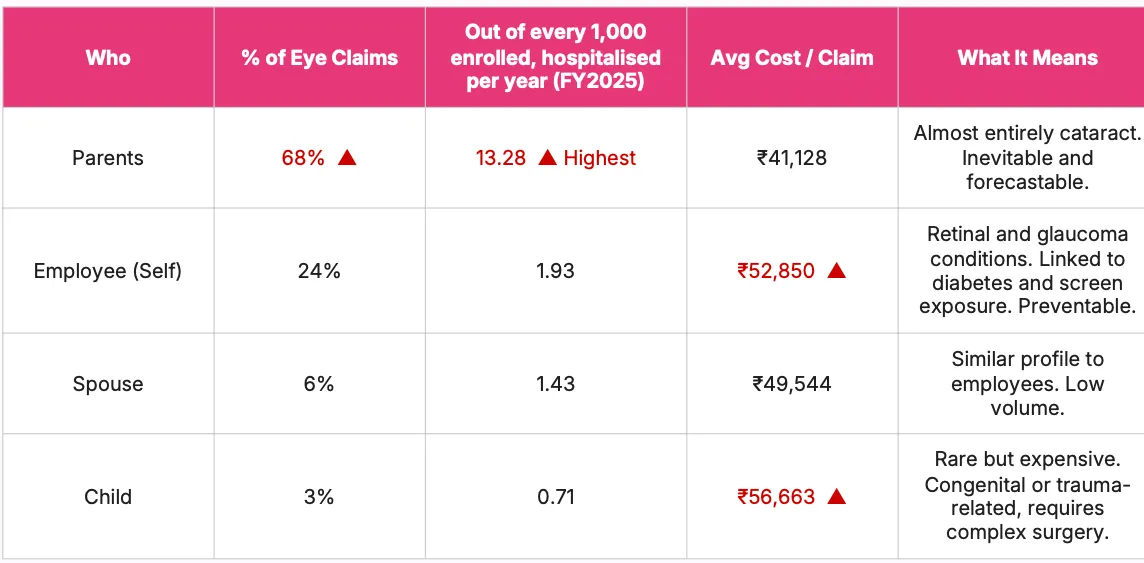
Cataract surgery is the highest-frequency elective procedure in the parent age group, and it carries unique characteristics that make it a consistent source of employee dissatisfaction with group health insurance policies. According to Pazcare's Employee Health Matters Handbook 2026, parents account for 66% to 68% of all eye disorder claims under group insurance for employees, with cataract driving 64% of all eye disorder claims.
The cost per procedure is moderate compared to cardiac or cancer claims, typically Rs40,000 to Rs60,000 per eye for standard phacoemulsification surgery at a private hospital. But the volume is high, both eyes typically require surgery, and most group health insurance policies apply sub-limits to cataract coverage of Rs20,000 to Rs40,000 per eye, creating a consistent gap between what the policy covers and what the hospital charges.
The additional complication is lens upselling. Hospitals frequently recommend premium multifocal or toric intraocular lenses costing Rs20,000 to Rs1,00,000 per eye above the standard monofocal lens. Standard group health insurance cover does not extend to premium lens upgrades, meaning employees' parents face a choice between a standard covered lens and a premium uncovered upgrade at the most stressful possible moment: the discharge desk.
The frequency of cataract claims among parents, combined with the consistent policy-to-cost gap, makes this one of the most predictable sources of employee dissatisfaction with group health insurance plans. The NSS 80th Round documents that eye conditions in Telangana cost Rs28,897 per hospitalization, 77% above the national average,illustrating the metro premium that HR teams with urban-based workforces and their parents face.
What this means for your group health insurance policy
Each of the five treatment categories above creates a specific set of pressures on the group health insurance policy economics.
Premiums increase at renewal when claims ratios are elevated. A year in which multiple parents required cardiac surgery, one underwent a renal transplant, and several filed cancer treatment claims will produce a claims ratio that prompts the insurer to reprice the policy at renewal, sometimes significantly. HR teams who did not anticipate this trajectory have limited leverage in negotiating renewal terms.
Policy restructuring becomes necessary as the parent cohort ages. A sum insured that was adequate for a parent population averaging 58 years of age becomes inadequate five years later for the same population at 63. Claim values rise with age, and a policy that has not been proactively reviewed will develop coverage gaps that become visible only when a large claim is filed and the employee's family is left with a significant out-of-pocket balance.
Coverage limits become a source of HR dissatisfaction when they are not clearly communicated in advance. Sub-limits on cataract, orthopedic implants, and specific cancer treatments feel like broken promises to employees when they encounter them at the point of care. HR teams who understand the policy terms and communicate them proactively before a claim is filed manage expectations and maintain trust.
How HR teams can manage parental claims without cutting benefits
1. Introduce a parental co-payment structure
A co-payment clause requires the employee to pay a fixed percentage, typically 10% to 20%, of the claim amount when a parent's hospitalization is covered. This shared cost structure reduces claims misuse, moderates the insurer's risk exposure, and typically results in a meaningfully lower premium at renewal. It does not eliminate coverage. It distributes the cost more equitably between the employer and the employee, which is particularly relevant for high-cost parent claims.
2. Offer optional parental cover with employee contribution
Rather than including parent coverage as a standard component of the group health insurance plan for all employees, offer it as an opt-in add-on where employees contribute a portion of the parent premium. This structure ensures that only employees with parents who genuinely need corporate coverage enroll them, reducing the moral hazard of enrolling parents primarily because coverage is free, and distributing the actuarial risk more accurately.
3. Create a separate sum insured for parents
When parents share a floater sum insured with the employee, spouse, and children, a large parent claim exhausts coverage that the employee and their immediate family need. A separate sum insured for parents, even at a lower amount than the employee floater, protects the employee's own coverage and makes the overall policy structure more sustainable. Pazcare's data consistently shows that organizations with separate parent floaters have more predictable renewal pricing than those using a combined family floater.
4. Focus on preventive care to reduce downstream claim severity
The most expensive claims in the five categories above share a common characteristic: they are the consequence of conditions that were present and progressing for years before the hospitalization that generated the claim. A parent who undergoes bypass surgery at 67 had elevated cholesterol and hypertension throughout their 50s. Annual preventive health checkups that include cardiac screening, HbA1c for diabetes, kidney function tests, and eye examinations can identify these conditions early, enabling management through medication rather than surgery.
Group health insurance plans that include a structured annual checkup benefit for parents, and that track whether employees actually use it, reduce long-term claim severity even if they have a modest short-term cost.
5. Use corporate buffers and top-up structures strategically
A corporate buffer is a pooled fund available to the organization that supplements individual employee coverage when claims exceed the sum insured. For high-cost parent claims like cardiac surgery or cancer, a well-structured top-up or super top-up policy alongside the base group health insurance cover provides protection against catastrophic claim events without requiring the base policy sum insured to be set at a level that makes the annual premium unsustainable.
How Pazcare helps you manage parental claims in group health insurance
Pazcare works with HR teams at startups and SMEs to design group health insurance plans that account for parental claim patterns specifically, not just employee health needs generically. Using actual claims data from its portfolio, Pazcare helps HR teams understand the age distribution of enrolled parents, model which claim categories are most likely to materialize over the next renewal cycle, and structure the policy terms including sum insured, co-payment, and preventive care benefits accordingly.
Beyond policy design, Pazcare's claims support team actively manages parent hospitalizations in real time: ensuring cashless authorization is processed within IRDAI-mandated timelines, flagging situations where lens upselling or implant upgrades are being suggested beyond what the policy covers, and helping employees navigate complex cancer or cardiac claim situations without being left to deal with the hospital and insurer alone.
For HR teams who want to include parents in their group insurance for employees without surrendering control of their renewal pricing, Pazcare provides the data infrastructure, broker expertise, and claims management support to make that possible.
Palak is passionate about driving conversations around employee health, wellness, and HR trends. With experience in content and growth strategy, her insights have been published in leading platforms, including The Times of India. Through her writing, she shows how small shifts in employee benefits can create lasting impact on workplace health and productivity.
Follow on:
Thanks for subscribing! If it’s your first time, check your inbox. Otherwise, you’re already on our list
Oops! Something went wrong while submitting the form.
Ready to give yourself and your team the best employee benefit experience?
Some employee group health insurance plans allow employees to include parents or parents-in-law. In many companies, parental coverage is offered as an optional benefit where employees can pay an additional premium.
Does group medical insurance cover parents?
Yes, many group medical insurance policies allow employers to include parents or parents-in-law, either as part of the base plan or as an add-on.
Should I get a separate policy for my parents?
Yes. With the GST exemption, individual policies for parents offer greater affordability and flexibility.
Can parents be added to group health insurance?
Yes, you can add parents/in-laws, spouses, and children to your group health insurance policy.
Does covering parents increase the premium significantly?
Premiums are higher due to age-related risk, but costs can be managed with co-pay, caps, or voluntary add-ons.
Can employees cover both parents and in-laws under group health insurance?
Yes. Many insurers, including Pazcare’s partners, allow coverage for both, often under a single floater plan.










.svg)
.svg)